
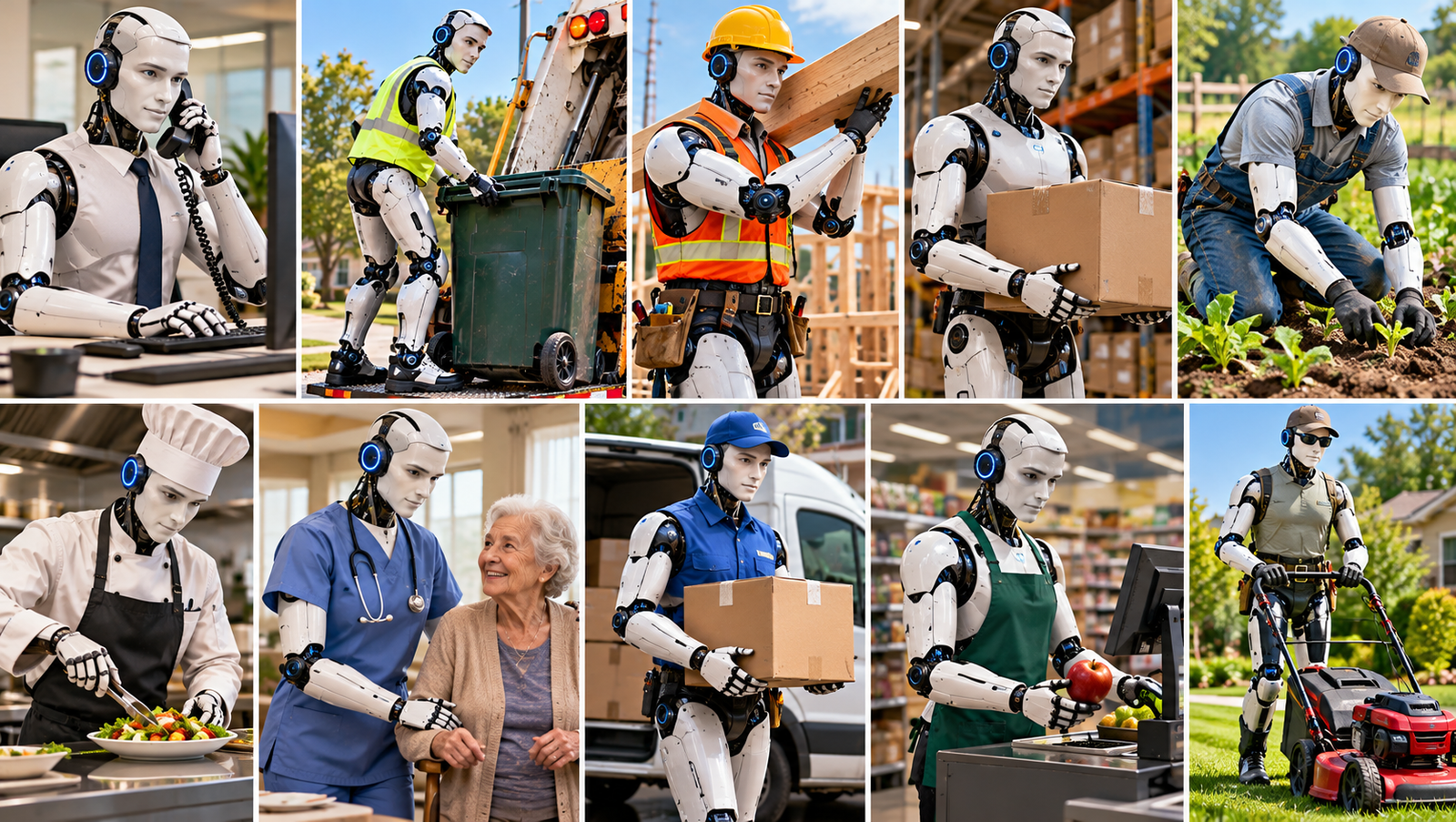
Artificial intelligence is changing the way we work, earn money, and live. The question is no longer whether AI will affect our lives, but how we can prepare for a future in which traditional employment may no longer provide the security it once did.
A Different Kind of Industrial Revolution
Throughout history, technological advances have changed the way people earn a living. The Industrial Revolution replaced much of the work once performed by hand. Tractors reduced the need for agricultural labor. Computers transformed offices, factories, and businesses.
Each advancement eliminated some jobs while creating others.
But artificial intelligence presents a different challenge.
For the first time, machines are performing tasks that once required human reasoning, writing, creativity, research, and decision-making. AI can produce advertisements, write computer programs, analyze financial information, create illustrations, answer customer questions, and perform administrative work.
And it is improving rapidly.
Unlike earlier machines that primarily replaced physical labor, AI is increasingly capable of performing intellectual tasks.
This raises an uncomfortable question:
What happens when technology can perform a growing share of the work that people depend on for their income?
So I asked ChatGPT for the answer. Here it is….
Will AI Take Our Jobs?

Some jobs will disappear. Others will change dramatically, and entirely new occupations will emerge.
The International Labour Organization estimated in 2025 that approximately one in four workers worldwide held occupations with some exposure to generative AI. However, it emphasized that most affected jobs were more likely to be transformed than eliminated.
The World Economic Forum’s Future of Jobs Report 2025 projected substantial employment disruption by 2030, with both new jobs created and existing positions displaced.
These are forecasts, not guarantees. The pace and consequences of automation will depend on economics, regulation, business decisions, and how people adapt.
Certain kinds of work appear especially vulnerable:
- Routine office administration and data entry
- Basic customer support
- Transcription and document processing
- Standardized writing and content production
- Some bookkeeping and accounting tasks
- Repetitive programming and digital production
- Routine research and information processing
Even skilled professionals may find that AI allows fewer employees to accomplish the same amount of work.
However, many occupations still depend heavily on physical presence, practical judgment, human relationships, and specialized experience.
Electricians, plumbers, mechanics, nurses, caregivers, farmers, and repair technicians perform work that cannot simply be completed by generating text on a computer.
Robotics may eventually change some of these occupations, too, but widespread physical automation faces additional costs and practical challenges.
The important lesson is not that every job will disappear. It is that relying on one job or one skill may become increasingly risky.
The Real Danger: Losing Our Ability to Support Ourselves
For most families, survival depends on a steady income.
That income pays for housing, food, electricity, transportation, insurance, medical care, and countless other necessities.
If employment becomes less predictable, even a temporary interruption can threaten financial stability.
Many households are already dependent on systems they cannot control. They purchase nearly all their food, rely on public utilities, and need regular income to maintain their standard of living.
AI may increase economic productivity, but those benefits will not necessarily be distributed equally.
Some business owners and workers may become more prosperous. Others may experience reduced hours, lower earnings, or difficulty finding employment.
We cannot know exactly how these changes will unfold.
But we can begin reducing our vulnerability today.
1. Build More Than One Source of Income

One of the strongest defenses against economic uncertainty is having several ways to earn money.
This does not mean everyone needs to operate five businesses. It means developing skills, products, or services that can provide income when one source becomes unreliable.
Consider opportunities such as:
Local services: Lawn care, cleaning, gardening, pet sitting, equipment maintenance, home repairs, and other services that require someone to perform physical work.
Handmade products: Sewing, woodworking, jewelry, crafts, soaps, candles, and personalized gifts.
Food-related businesses: Selling permitted baked goods, seedlings, herbs, garden produce, or other locally produced items, subject to applicable food-safety and business regulations.
Teaching practical skills: Gardening, sewing, cooking, food preservation, basic repairs, and other skills people want to learn.
Online businesses: Educational materials, specialized publications, digital products, consulting, and niche websites.
AI may help with advertising, recordkeeping, customer communication, and planning. But the actual product, personal service, experience, or local relationship can remain distinctly human.
Start small. Test whether customers are willing to pay before investing heavily in equipment or inventory.
The objective is to create an additional source of income without placing your existing financial security at unnecessary risk.
2. Learn to Use AI Instead of Ignoring It

Artificial intelligence is not only a threat to employment. It can also be a useful tool for individuals and small businesses.
Someone starting a small gardening business might use AI to develop a business plan, organize appointments, draft advertisements, and prepare customer estimates.
A craftsperson might use it to research markets, organize inventory, or create product descriptions.
A person with limited technical experience may be able to build a basic website or learn new computer skills with AI assistance.
These capabilities can reduce the cost of starting and operating a business.
However, AI makes mistakes. Its answers should be checked, particularly when dealing with legal requirements, financial decisions, medical information, safety procedures, or technical instructions.
Avoid entering sensitive customer information or private financial records into tools without understanding their privacy practices.
The goal is to make AI work for you, not to surrender your judgment to it.
3. Rediscover the Value of Practical Skills

For generations, families routinely performed tasks that many people now pay others to do.
They grew vegetables, repaired clothing, maintained tools, preserved food, and fixed things around the house.
As society became more specialized, many of these skills gradually disappeared from everyday life.
An uncertain economy makes them valuable again.
Learning to repair a leaking faucet, grow tomatoes, mend clothing, maintain a bicycle, or prepare inexpensive meals can reduce the amount of money a household needs.
Some of these abilities can also become sources of income.
Imagine two families experiencing the same reduction in income.
One family must purchase nearly everything it needs.
The other grows some of its food, knows how to repair common household items, prepares meals from basic ingredients, and has several marketable skills.
Neither family is immune to hardship, but the second has more options.
Practical knowledge provides a form of security that cannot be measured entirely in dollars.
4. Grow Some of Your Own Food
Food production is one of the most useful areas of backyard self-sufficiency.
You do not need a farm to begin.
A few raised beds, containers, or a small garden can provide fresh vegetables, herbs, and seasonal produce.
Start with crops suited to your climate and growing space.
Tomatoes, peppers, beans, leafy greens, sweet potatoes, and squash are possibilities, depending on your region and season.
Focus first on learning how to grow food successfully rather than attempting to produce everything your family eats.
As your experience increases, consider learning seed saving, composting, food preservation, and season extension.
A garden may not replace your grocery budget, especially after accounting for supplies and labor. But it can supplement your food supply, improve your skills, and provide greater independence.
It can also become a small income opportunity through seedlings, herbs, or surplus produce where local regulations permit.
5. Reduce the Amount of Money You Need to Survive
Increasing income is important, but reducing necessary expenses can be equally powerful.
Suppose a household needs $4,000 each month to cover essential expenses.
If careful changes reduce that amount to $3,200, the family has lowered its monthly income requirement by $800.
That represents $9,600 annually.
Not every household has that much flexibility, but even smaller reductions can make a meaningful difference.
Begin by examining recurring expenses:
- Unused subscriptions and unnecessary services
- Expensive convenience foods and frequent takeout
- Energy waste and inefficient appliances
- High-interest debt
- Transportation costs
- Products that could be repaired rather than replaced
Concentrate on changes that provide lasting savings without creating new safety problems or excessive upfront costs.
A lower cost of living creates freedom. It may allow you to accept part-time work, develop a business, retrain for a new occupation, or endure a period of unemployment.
6. Make Your Home More Resilient

Self-sufficiency does not necessarily mean living completely off the grid.
It means having alternatives when ordinary systems fail.
A resilient household might maintain an emergency food supply, store drinking water, keep essential medications and first-aid supplies available, and develop a plan for extended power outages.
Where practical and affordable, backup power, rainwater collection for permitted uses, and alternative cooking arrangements may improve preparedness.
Even a modest emergency supply can reduce the pressure to purchase necessities during a crisis.
Begin with the basics before investing in expensive systems.
Remember that generators, batteries, water treatment equipment, and alternative heating devices must be installed and operated safely.
The objective is not isolation from society. It is reducing dependence on any single system.
7. Invest in Skills That Remain Valuable

No occupation is guaranteed to remain untouched by AI.
Nevertheless, certain abilities may remain useful across many industries.
These include:
- Diagnosing and solving real-world problems
- Maintaining and repairing equipment
- Caring for children, older adults, and people with disabilities
- Teaching and communicating effectively
- Managing projects and working with customers
- Understanding agriculture, construction, and energy systems
- Evaluating information and making sound decisions
- Learning unfamiliar tools and technologies
Combining practical experience with digital skills may be particularly valuable.
For example, an experienced mechanic who uses AI to research repair information still needs the judgment to diagnose the actual problem and perform the repair safely.
A gardener who uses technology to plan planting schedules must still understand soil, weather, pests, and plant health.
AI can assist with information, but real-world results require knowledge, responsibility, and experience.
8. Strengthen Local Communities

One often-overlooked form of security is knowing your neighbors.
Communities become more resilient when people exchange knowledge, help one another, and support local businesses.
A retired carpenter may teach basic woodworking.
An experienced gardener may share seeds and seedlings.
Neighbors may exchange tools, assist with repairs, or organize community gardens.
Local relationships can also create employment opportunities that are not dependent on distant corporations or online platforms.
Bartering may be useful in some circumstances, although goods and services exchanged through barter can have tax implications.
The more capable and connected a community becomes, the better positioned it may be to respond to economic disruptions.
9. Prepare Financially for an Uncertain Transition

If your employment could be affected by automation, preparation should begin before your income disappears.
Build an emergency fund if your circumstances allow. Even a small reserve can help cover unexpected expenses.
Review your debt, understand your employment benefits, and keep your résumé and professional contacts current.
Investigate training programs before paying for expensive courses. Look for evidence that the skills are genuinely in demand.
If you lose your job, explore unemployment benefits, workforce development programs, and other assistance for which you may qualify.
Avoid risky investments or expensive business ventures based solely on predictions about AI.
The future is uncertain, and protecting the resources you already have is an important part of preparation.
10. What Happens If There Simply Aren’t Enough Jobs?

This is the larger question society must eventually confront.
If machines produce more goods and services with fewer human workers, how will people obtain the income needed to purchase those goods and services?
Economic growth does not automatically guarantee that everyone benefits equally.
Possible responses being debated include shorter workweeks, expanded worker retraining, stronger unemployment protections, wage subsidies, and forms of guaranteed income.
Universal basic income is one proposal, although questions remain about funding, inflation, eligibility, and its effects on employment and public services.
Other approaches focus on helping workers share in productivity gains through wages, ownership, profit-sharing, or public policy.
There is no universally accepted solution.
These decisions will require public discussion, economic evidence, and political choices.
Individual self-sufficiency can reduce vulnerability, but it cannot solve every consequence of large-scale economic change.
A Practical 30-Day Plan for Preparing for the AI Economy

You do not need to transform your entire life immediately.
Begin with a manageable plan.
Week 1: Understand your situation. Review your household expenses, income sources, savings, and the tasks in your occupation that AI may increasingly perform.
Week 2: Learn something useful. Experiment with an AI tool, practice a marketable skill, or begin learning a practical household skill that could save money.
Week 3: Build a little independence. Plant a small garden, improve your emergency supplies, repair something instead of replacing it, or eliminate an unnecessary recurring expense.
Week 4: Explore an income opportunity. Identify a product or service you could offer, speak with potential customers, and test the idea on a small scale.
At the end of the month, choose one promising activity to continue.
Small improvements accumulate over time.
The Future Belongs to Those Who Can Adapt

Artificial intelligence is here, and it is unlikely to disappear.
It may bring remarkable improvements in medicine, science, education, manufacturing, and everyday life.
It may also disrupt careers, concentrate wealth, and challenge assumptions about how people earn a living.
We cannot predict every consequence, and fear alone will not prepare us.
But we can make ourselves less vulnerable.
We can learn new technology while preserving practical knowledge. We can develop additional sources of income, reduce unnecessary expenses, grow some of our food, strengthen our communities, and prepare our homes for unexpected difficulties.
Most importantly, we can teach the next generation that survival depends on more than holding a particular job.
Be prepared!
It depends on adaptability, resourcefulness, cooperation, and the ability to create value in a changing world.
AI may change how we earn our living, but we can still take meaningful steps toward controlling how we live.
The time to begin is now.